|
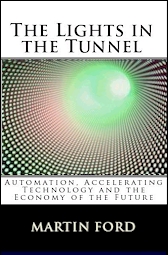
(Paperback at Amazon.com) 
(Amazon price subject to change)
Trade Paperback, 260 pages
 
Kindle Version - $3.95

PDF eBook


Listen to an Interview
with the author at

What does the title "The Lights in the Tunnel" mean?
The book uses a unique approach: it creates a mental simulation (or imaginary video game) based on "lights in a tunnel" in order to help the reader visualize the future economic impact of accelerating technology.
|
What will the economy of the future look like?
Where will advancing technology, job automation, outsourcing and globalization lead?
Is it possible that accelerating computer technology was a primary cause of the current global economic crisis—and that even more disruptive impacts lie ahead?
This groundbreaking book by a Silicon Valley computer engineer and entrepreneur explores these questions and shows how accelerating technology is likely to have a highly disruptive influence on our economy in the near future—and may well already be a significant factor in the current global crisis.
"Provocative" "its logic will haunt you"
— The Washington Post
| THE LIGHTS IN THE TUNNEL employs a powerful thought experiment to explore the economy of the future. An imaginary "tunnel of lights" is used to visualize the economic implications of the new technologies that are likely to appear in the coming years and decades.
The book directly challenges nearly all conventional views of the future and illuminates the danger that lies ahead if we do not plan for the impact of rapidly advancing technology. It also offers unique insights into how technology will intertwine with globalization to shape the twenty-first century and explores ways in which the economic realities of the future might be leveraged to drive prosperity and to address global challenges such as poverty and climate change.
Excerpt: Read the:
Introduction | Table of Contents
Read Recent Reviews and News Items
Follow the author on Twitter: @MFordFuture
|
|
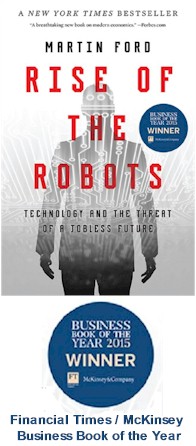
The new New York Times bestselling book by Martin Ford:
|
Read the author's blog on Future Economics and Techology at mfordfuture.com.
|
The Lights in the Tunnel: Automation, Accelerating Technology and the Economy of the Future
This new book takes an in depth look at current trends in technology and globalization and examines what the likely economic impact will be in the coming years and decades.
Here are just a few of the questions explored in this book:
-
How will job automation impact the economy in the future?
-
How will the offshore outsourcing trend evolve in the coming years?
-
What impact will technologies such as robotics and artificial intelligence have on the job market?
-
Did technology play a significant role in the 2007 subprime meltdown and the subsequent global financial crisis and recession?
-
How fast can we expect technological change to occur in the coming years and decades?
-
Which jobs and industries are likely to be most vulnerable to automation and offshoring?
-
Globalization. Collaboration. Telecommuting. Are these the forces that will shape the workplaces of the future? Or is there something bigger lurking?
-
Machine and computer automation will primarily impact low skilled and low paid workers. True or false?
-
Will advancing technology always make society as a whole more wealthy? Or could it someday cause a severe economic depression?
-
What are the implications of advancing automation technology for developing nations such as China and India?
-
The primary economic trend in the coming decades will be globalization. True or false?
-
Will a college education continue to be a good bet in the future?
-
Recent economic data suggests that, in United States, we are seeing increasing income inequality and a dwindling middle class. How will this trend play out in the future?
-
What will be the economic impact of truly advanced future technologies, such as nanotechnology?
-
Retail positions at Wal-mart and other chain stores have become the jobs of last resort for many workers. Will robots and other forms of machine automation someday threaten these jobs? If so, what alternatives will the economy create for these workers?
-
Do we need to adapt our market-based economic system to advancing technology or will the same rules continue to work indefinitely?
-
What government policies might make sense as technology continues to accelerate?
-
Read the: Introduction | Table of Contents
|
